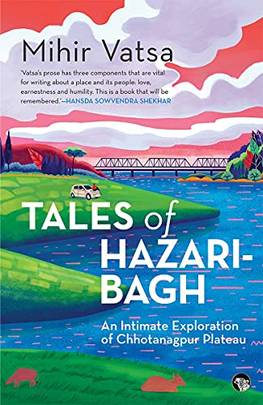
Tales Of Hazaribagh An Intimate Exploration Of Chhotanagpur Plateau
by Mihir Vatsa
Tales Of Hazaribagh An Intimate Exploration Of Chhotanagpur Plateau
by Mihir Vatsa
Paperback
Rs 720
Delivery in 1-3 weeks
WINNER OF 2022 SAHITYA AKADEMI YUVA PURASKAR
In January 2017, Mihir Vatsa, a young poet, gives up his life in the big city and moves back home to Hazaribagh, a small town on Jharkhand’s Chhotanagpur Plateau. Battling depression and uncertainty, he is seeking a ‘sanatorium’ amidst the sal trees and the temperate climes of home—just like the British soldiers and Bengali settlers and visitors before him.
Rejuvenated by the fresh air and lush landscape of his childhood, he spends the next three years exploring local landmarks and their fascinating history, and the deep, wondrous escarpments, the secret waterfalls and serpentine rivers of the plateau. Travelling partly on foot and partly in his trusted Alto, he encounters trees destined for death and waterfalls ravaged by mining; passes through Surajkund—the country’s hottest geological wonder—and Karanpura Valley— home to prehistoric humans ten millennia ago; and takes selfies with emus.
In between, he wonders what makes a landscape beautiful and how language shapes such notions; muses on the arbitrary boundaries of administration and government which, try as they might, cannot tame rivers and hills; and plumbs the archives of previous residents of the plateau and his own memory to understand his love of home. With empathy and in unhurried prose, Tales of Hazaribagh combines the best of nature, life, history and travel writing into an unforgettable portrait of a place and a journey back to one’s self.
*
Top 10 non-fiction books of 2021— THEPRINT
This book is like Hazaribagh—it has a gentle gravity that keeps us with it as sleep does to dreams. Written to the speed of discovery, it moves gracefully through history, between the archive and experience, to leave us with a landscape that we will, from now on, remember like we do our bed. —SUMANA ROY
Vatsa's prose has three components that are vital for writing about a place and its people: love, earnestness and humility. This is a book that will be remembered.— HANSDA SOWVENDRA SHEKHAR
A new form of non-chauvinistic, deeply immersive writing.— THE HINDU
A leisurely journey, chronicled in admirably simple diction, but there’s something unmistakably heroic about it.— THE WIRE
Poignant and lyrical genre-defying book.— BUSINESS STANDARD
Goes beyond conveying the allure of Hazaribagh to underscore the redemptive potential of travel.— HINDUSTAN TIMES
Reads like a gentle, preternaturally wise voice from the future, telling us about the perils and pitfalls of our flawed, helter-skelter modernity.— MINT LOUNGE
What enriches the reader, hitching an imaginary ride along with Vatsa in his Alto, is the entire arc comprising characters, history, politics, environmental concerns and even literature that the journey covers — or uncovers.— THE TELEGRAPH
In January 2017, Mihir Vatsa, a young poet, gives up his life in the big city and moves back home to Hazaribagh, a small town on Jharkhand’s Chhotanagpur Plateau. Battling depression and uncertainty, he is seeking a ‘sanatorium’ amidst the sal trees and the temperate climes of home—just like the British soldiers and Bengali settlers and visitors before him.
Rejuvenated by the fresh air and lush landscape of his childhood, he spends the next three years exploring local landmarks and their fascinating history, and the deep, wondrous escarpments, the secret waterfalls and serpentine rivers of the plateau. Travelling partly on foot and partly in his trusted Alto, he encounters trees destined for death and waterfalls ravaged by mining; passes through Surajkund—the country’s hottest geological wonder—and Karanpura Valley— home to prehistoric humans ten millennia ago; and takes selfies with emus.
In between, he wonders what makes a landscape beautiful and how language shapes such notions; muses on the arbitrary boundaries of administration and government which, try as they might, cannot tame rivers and hills; and plumbs the archives of previous residents of the plateau and his own memory to understand his love of home. With empathy and in unhurried prose, Tales of Hazaribagh combines the best of nature, life, history and travel writing into an unforgettable portrait of a place and a journey back to one’s self.
*
Top 10 non-fiction books of 2021— THEPRINT
This book is like Hazaribagh—it has a gentle gravity that keeps us with it as sleep does to dreams. Written to the speed of discovery, it moves gracefully through history, between the archive and experience, to leave us with a landscape that we will, from now on, remember like we do our bed. —SUMANA ROY
Vatsa's prose has three components that are vital for writing about a place and its people: love, earnestness and humility. This is a book that will be remembered.— HANSDA SOWVENDRA SHEKHAR
A new form of non-chauvinistic, deeply immersive writing.— THE HINDU
A leisurely journey, chronicled in admirably simple diction, but there’s something unmistakably heroic about it.— THE WIRE
Poignant and lyrical genre-defying book.— BUSINESS STANDARD
Goes beyond conveying the allure of Hazaribagh to underscore the redemptive potential of travel.— HINDUSTAN TIMES
Reads like a gentle, preternaturally wise voice from the future, telling us about the perils and pitfalls of our flawed, helter-skelter modernity.— MINT LOUNGE
What enriches the reader, hitching an imaginary ride along with Vatsa in his Alto, is the entire arc comprising characters, history, politics, environmental concerns and even literature that the journey covers — or uncovers.— THE TELEGRAPH
All Editions
Paperback
ISBN13: 9789354470387
Speaking Tiger, 2021
Share Your Thoughts
Your review helps others make informed decisions
Click on a star to start your review