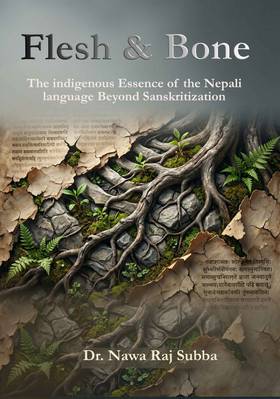
Flesh and Bone The indigenous Essence of the Nepali Language Beyond Sanskritisation
E-book
For ages, one narrative has set the terms for identity in the Central Himalayas – that the Nepali language is the authentic "daughter of Sanskrit", originating in the hills of Khas, of pristine origin and civilised by institutional standardisation by only elites. However, upon peeling off the layer of state institution-driven polish, what lies beneath?
Bones and Skin: A Decolonial History and the Indigenous Foundations of the Nepali Language is an outstanding and evidence-based counter-attack against a hundred-year-long elite scholarly paradigm by none other than the pioneering scholar, Dr Nawa Raj Subba. Shifting conventional linguistic scholarship from its head, Dr. Subba employs an astute metaphor in that the bones of Nepali grammatical structure, phonology and existentials – all sprout from the earthy indigenous Tibeto-Burman, Magar, Newar, Kiranti and Mundhumi knowledge base. The Sanskrit-Tatsam loan words are nothing but a historically imposed, thin and transparent "skin" layered over this dynamic, multi-hued "bone".
With a scope of 22 robust chapters, this work interweaves historical sociology, the Sinja Empire's inscriptions, 2078 B.S. National Census findings and digital humanities. Through this book, we will learn how "purism" by the elites becomes a weapon of internal colonialism, and we will get the map for how the Nepali language itself has lived its hybrid, translinguistic life through the realities of the modern global diaspora. Bones and Skin is not only a linguistic critique, but it's also a decolonial manifesto to free the Nepali language from the fetters of institutional politics.
- Technologicalization and open access to the Limbu language (Sirijanga script) and the Mundhum knowledge system (Open Access) How to spread for global human welfare through.
A must-read document for every reader, writer, and researcher who wants to understand the politics, history, legal sociology, and digital future of the Nepali language from a new perspective!
Share Your Thoughts
Your review helps others make informed decisions
Click on a star to start your review