

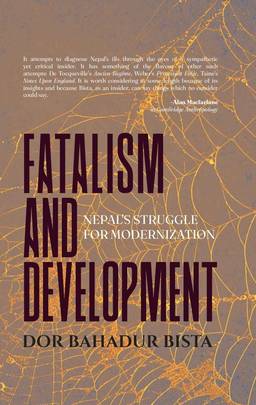
Fatalism and Development Nepal's Struggle for Modernization
Paperback
From the backcover
A bold and incisive analysis of Nepal's society, and its attempts to develop and respond to change, from someone who is both an insider and an outsider to Nepal. At an early age Dor Bahadur Bista travelled all over Nepal in the company of the leading anthropologist Christoph von Furer-Haimendorf which helped him to acquire an insight that enables him to make an objective and frank comment on his country.
Nepal has a heteronomous society with a complex ethnic mix. According to Bista, in certain areas of Nepal can be found the positive social qualities that can generate and sustain progress-a commitment to productive labour, a high capacity for endurance, efficient cooperative organizational styles, and a high adaptive propensity at individual and social levels. But these positive elements are threatened by an alien culture; it is the culture of fatalism, which has an inherent conflict with development. This culture devalues the concept of productivity. Since this culture is becoming more pervasive, the productive sector of the society is getting discouraged in the proportion that the fatalistic sector is being encouraged. As a result, development activity is due to an infusion of external aid, whose beneficiaries are not always those who contribute to growth.
Nepal's strengths have always been in the indigenous qualities of its various ethnic groups. But it has been under the influence of other cultures which have suppressed its own strengths. He believes, that while Nepal should be open to other cultures, they should be scrutinized and their negative elements purged before they are adopted. Nepal's future hope lies in its ethnic cultures whose simplicity provides a greater flexibility and thus a greater propensity to development and change, than the cumbersome and ossified structure of the urbane upper class, and caste, society of the Kathmandu Valley.
All Editions
Share Your Thoughts
Your review helps others make informed decisions
Click on a star to start your review